My first helicopter ride ever!!! woot woot!
The flight in was actually really quite interesting for me – we passed over huge glaciers that literally looked like rivers of ice. I’ve been to Glacier National Park in Montana, and seeing these valleys filled with rivers of ice really reminded me of the valleys I’d seen in Montana. It was actually really interesting to imagine that Glacier National Park at one point probably looked a lot like this.

Here we are flying over the Royal Society Range deeper into the TransAntarctic Mountain Range. It really does look like rivers of ice.

This is a picture I took when I was at UC Berkeley on a geology field trip to Glacier National Park in Montana. This valley was at one time filled with glacial ice, much like the valleys in Antarctica. It's incredibly to imagine just how much ice that is.
Eventually, after many, many pictures and several videos, we made it to our camp site in Upper Mullins Valley.

Here we are spotting our camp site from the helicopter (the yellow tents to the left of the valley). This is a good shot up Mullins Valley Glacier. The headwall is the accumulation zone where the glacier actively accumulates snow and ice. The valley itself is covered in a debris layer that arises as a sublimation till - surrounding ice sublimates to the atmosphere, leaving rock debris that fell in from the headwall behind. The glacier is slowly moving down the valley ~1cm/yr.
The campsite was already set up because the group had already arrived in Mullins actually a month ahead of me. The group itself was quite small – there were 5 of us total for about a week, and then Dave left, leaving just 4 of us.
Dave Marchant – professor, Boston University
Geomorphologist – focusing on cold region geomorphology with paleoclimate and extra-terrestrial implications
Sean Mackay – graduate student, Boston University
Geomorphologist – studying Mullins Valley glacier geomorphology as a paleoclimate indicator
Jen Lamp – graduate student, Boston University
Geomorphologist – studying rock fracture mechanics
Greg Wissink – undergraduate student, Boston University
Geology major – studying to be a graduate student
Audrey Yau – graduate student, Princeton University
Geochemist – studying the air trapped in glacial ice for paleoclimate significance

From left to right: Jen Lamp, Sean Mackay, and Dave Marchant talking science

Greg Wissink cooking dinner

Me enjoying one of my favorite days out in the field - an overcast, chilly, but beautiful day.
It was a bit strange at first, acclimating to camp life, especially because the camp had already been set up for a while. It took a few days to get accustomed to the established camp procedures, but it wasn’t terrible. It was actually a good thing that I had met the rest of the team before at Boston University.
The strangest things for me were
1. Walking. You may laugh, but walking in Antarctic designed boots (FDX boots or Bunny boots) is pretty difficult….especially when you’re walking on a jumble of rocks. The shoes themselves are almost a pound each, and they’re huge. It literally feels like you’re walking in rubber shoes, three sizes too big. It didn’t help that Mullins Valley glacier is covered by a sublimation till (a layer of debris brought to the surface of the glacier as surrounding ice sublimates). Walking on the sublimation till was very much like walking on scree (piles of loose rock that are precarious to walk on, forming slopes at the foot of a wall from rockfall). The reason why it was so difficult and dangerous was because the rocks would often turn or slide out beneath you, causing you to twist your ankle or fall down. In the first week, I fell 4 times, and I still have the bruises to show for it.

Treading carefully....
2. Peeing into a bottle. Antarctica has very stringent waste and recycling procedures as part of efforts to keep Antarctica as clean and pristine as possible. So, the policy is: bring everything you take with you out, and leave nothing behind. This includes all the scientific equipment not used in long-term analysis, all the gear we take with us, all the food we take with us, and all the waste generated during the field season. As a result, we pee into bottles and poop into buckets. It’s really exciting….I guess you would think that after 4 weeks, I’d be a pro at peeing into a bottle….but I’m not. Even up to the last day, I was still peeing on my hand. Honestly, sometimes boys have it so easy.

In theory so simple.....and yet so difficult.
3. Not washing my hands (especially after peeing into a bottle). Again, because of the strict waste procedures, our camp was designated a ‘no gray water’ camp. This means that no waste water is allowed to be generated – no water for washing your hands, no water for washing dishes, no excess water can be dumped from cooking (which means all the water needs to be up when cooking pasta), and etc. But that isn’t to say that all sanitation goes out the window – Purell was definitely a life saver.

It's beautiful out here - and we want to keep it that way.
4. Brushing my teeth without water. Again, along the guidelines of no gray water. We weren’t allowed to use water to rinse our mouths after brushing our teeth. Members of our team all adapted different ways to brush our teeth. Some would just swallow the toothpaste (something I couldn’t do), and others would just spit into a sanitary waste bag (which is what I preferred to do). But still, it was a bit odd not being able to rinse my mouth with water.

Sitting inside the cook tent, showing off my freshly brushed teeth.
5. Sleeping with my sunscreen and water bottle. In the beginning of the season, when it was a bit colder (between -10 C and -15 C), the water in my water bottle, my sunscreen, and toothpaste would freeze overnight, which was sort of a pain. So, I had to sleep with those items in my sleeping bag. It’s funny how you take ‘room temperature’ for granted sometimes.

Frozen olive oil....not the only frozen thing we had out in the field.
6. Eating junk food pretty much all the time. When you’re out in the field for 4 weeks in an environment that’s very extreme, it’s important to make sure you have enough food (calories really) that will keep you energized. And, it is very important that that food will also last for 4 weeks without going bad. With these two requirements, the food we were able to take with us was rather limited. Basically, we were limited to packaged foods and frozen foods (this worked because we were basically living in a huge outdoor freezer – temperatures rarely get above freezing in Mullins Valley). So, chocolate bars, jars of peanut butter, energy bars, packaged mashed potatoes, cabin bread, pasta, frozen meats and vegetables, canned beans, oatmeal, and other deliciously unimaginative, not-very nutritious items were our staple foods. Yum…..

A typical lunch - cabin bread and peanut butter - how exciting! Sorry the picture was a bit foggy - that happens when it's really cold out and then you go inside a tent which tends to be warmer. The water vapor condenses on the lens.
7. Not showering. Perhaps one of the strangest things for me (since I shower everyday usually), was not being able to shower. In fact, I didn’t shower for nearly 4 weeks. It was surprisingly not as gross as I thought it would be. At some point – probably by the end of the second week, I noticed that I didn’t really seem to be getting any dirtier. I guess that makes sense – we are adapted to survive without a daily shower, though most of us don’t let ourselves go that long without bathing, so our body does achieve some homeostatic state of natural oils. Even my hair didn’t get much worse after a certain point. I did make a rather futile attempt at dred locks…unfortunately, I had no idea how that actually works, so that glorious idea failed. In truth, the not showering was actually not as bad as I thought it would be. But, it did help to once in a while wipe myself down with body wipes in a pseudo-shower, roughly once a week. And, it definitely helped to run a brush through my hair every day.

This picture was taken just after Christmas day - that's over 3 weeks without a shower. But it's worth it - I still can't believe how beautiful it was out there.
8. Never seeing the sunset or rise. Being so close to the pole during the southern hemisphere summer means that the sun is present 24 hours a day. So, for the past month, I haven’t seen the sunset or rise. I’m not sure whether I’m more surprised that the transition wasn’t as difficult as I thought it would be, or that I miss nighttime. I miss being able to see the stars, I miss watching the sky change colors as the sun hits the horizon, and I miss not have to put sunscreen on at 6pm. Actually, my favorite days in the field were the days when there were clouds in the sky or when it was actually overcast because it provided some contrast to the constant brightness of the sun. The sunlight was often so bright, it made everything look a little washed out. So, when it was a bit overcast, I felt like I could actually see the colors of the rocks and the ice.
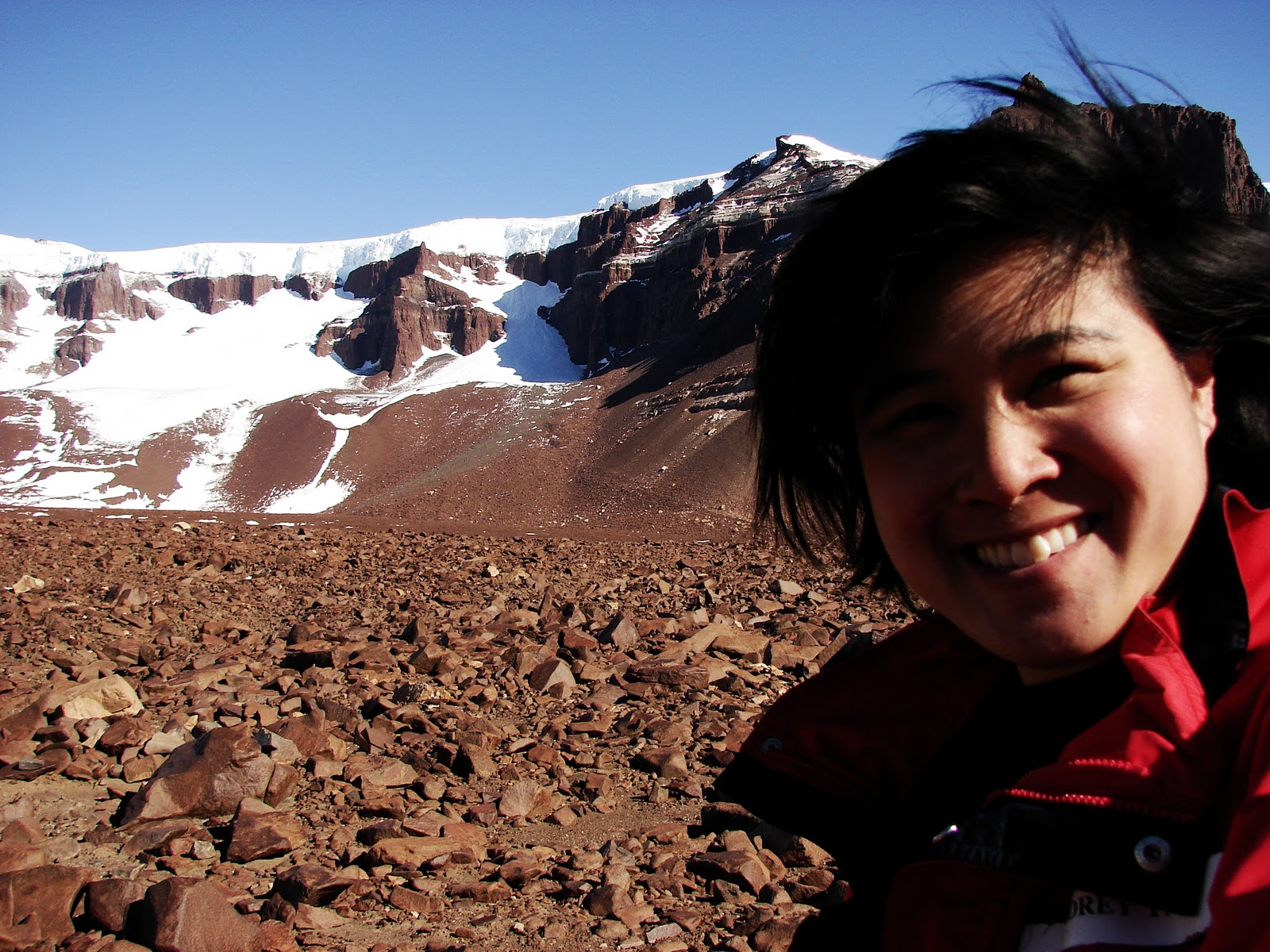
Another very sunny moment. One of many.
9. Not having the internet. Unfortunately, I have become increasingly reliant on the internet in the past few years, so the past month was a bit strange not having access to the internet and my email. Actually, though, it was sort of a welcome relief not always being ‘plugged in’ by either my own choice or the expectations of others, who generally expect 24 hour response times to emails. In fact, it was really nice to slow down and go back to ‘snail mail.’ Though to be honest, it was a bit hard, especially at the beginning of the season, when my fingers weren’t quite as dexterous in the cold….I’m afraid my penmanship in many of the letters I sent was a bit poor….

Reading a book, while stretching at the end of a long day of hiking and digging pits.
10. The lack of sound and smells. Perhaps the strangest thing about being out in Mullins Valley, Antarctica was just how quiet and empty it was out there. Besides the four of us out in the valley, there was nothing else but rocks and ice. On days when the wind wasn’t blowing, it was eerily quiet. You sometimes hear people describe absolute silence as a pressure on their ears – I think I might have to agree with that. But it wasn’t just the silence that was strange. It was also interesting that there were no smells out there. I didn’t catch onto it at first…..but as the season drew on, I realized that there was nothing that I could smell besides the food we cooked and the waste we generated (which, by the way, when it’s not diluted by the smells of other things in the air and not frozen solid, smells really, really bad).

A peaceful moment from where I was, watching a wind storm whip snow off of the glacier on the other side of the valley.
It took me a few days, but slowly I adjusted to life out in Mullins Valley. After one week in Upper Mullins Valley, we made a camp move down to Lower Mullins Valley (closer to the region where ice as old as 4 Ma (million years) is believed to exist. The camp move was a fun experience – a lot of work to gather up all of our gear and scientific equipment, but exciting because it involved another helicopter ride – this time with a belly-sling that carried all of our gear. Unfortunately camp moves are exhausting – every piece of gear must be packed and secured, then unpacked and re-secured. Over the two days it took us to prepare and do the camp move, I think I lifted and carried at least 1000 lbs of gear total. Well, I guess the plus side is that I’ve got muscles now. :)

Sitting in the helicopter, packed to the brim with gear, food, samples, and scientific equipment.
Overall, my arrival and adjustment to life in Mullins Valley was pretty smooth. I think it helped that I was mentally prepared for what was coming because I had talked to people who had already been here. My take away lesson is probably: Preparation is important, and practice is even better, but sometimes practice doesn’t always make perfect. (pee bottles….arrghhh….).